Stellar Marches
Summary
The Starfall Galaxy setting fuses the heart of this galaxy is not a land of utopias, but of colossal struggles, neon decay, and fleeting hope.
Adapted from Grimdark Future Lore - One-Page Rules and Starfinder Playtest
Starfall Galaxy’s Boundless Skies
The Starfall Galaxy setting fuses the heart of grimdark science fantasy with survival-driven mechanics. Inspired by Grimdark Future, Starfinder 2e, and Magic: The Gathering’s Color Pie, this galaxy is not a land of utopias, but of colossal struggles, neon decay, and fleeting hope. Every resource and risk revolves around survival—time itself is the coin of existence. Navigating the galaxy means weighing every faction’s devotion and every journey’s hazards, as interstellar travel runs through the perilous Rift, and the persistent possibility of cosmic disaster shapes the fate of worlds.
Starfall Galaxy
“Hope amid neon decay. That’s our mantra in the Starfall Galaxy. Time flickers in sandglasses, the Rift storm roars in the distance, and every trade, triumph, and trust is measured in hard-won Yoms.”
The Setting
The Starfall Galaxy is vast and ancient, rebuilt and reimagined in the aftermath of empires long fallen. From the shining decay of the Inner Sphere, to the lawless Outer Sphere, and the perilous Frontier, every region harbors ancient mysteries, powerful factions, and unpredictable dangers. The galaxy’s main currency is the Yom—a day of survival—used to gauge trade, fuel, and equipment. The economy’s instability makes timekeepers and the Chronologist Guild essential for prosperity.
The Rift
Interstellar travel and magic in Starfall rely upon the Rift, a psycho-reactive, unpredictable dimension that underlies real space. It is the source of all magic and a gateway for interstellar ships. Passage is fraught with peril—Rift-Taint, planar bleed, and wild time distortion threaten every voyage. Navigators, psychically attuned and highly trained, steer ships through unstable currents and protect passengers against unspeakable risks
Interstellar travel shouldn’t be possible, but the Rift makes it so. It is a psycho-reactive dimension that screams just beneath the skin of reality. It is the source of all magic (“Rift-binding”) and the only highway between stars. But the Rift hates you. It wants to bleed into our world, mutate your flesh, and steal your memories. Navigators don’t just steer ships; they psychically wrestle the currents of hell to keep you on course.
Factions and Power
Six primary factions vie for influence, each driven by devotion, ideology, and survival:
- Celestial Accord: Militarized, enforcing order and predictability. Guardians of the Rift-Gate network.
- Crimson Concord: Anarchists valuing emotion, freedom, and constant change. Performance warfare and neon chaos.
- Ebon Syndicate: Black market overlords—hyper-capitalist and ruthless, shaping galactic commerce from the shadows.
- Azure Archivists: Seekers of lost knowledge, cybernetic and emotionless, braving cosmic mysteries with machine precision.
- Riftsworn: Rift-mages and zealots fighting to dissolve reality’s laws and merge the galaxy with chaotic Rift energy.
- Viridian Ascent: Biopunk ecosystemists cultivating psychic unity and rejecting mechanical life, growing flesh citadels and living starships.
Each faction employs agents, alliances, and subterfuge—rarely does open warfare dominate politics, as memories of galactic devastation remain fresh.
The Passage of Time
Time’s unreliability is a constant anxiety: Rift journeys can send travelers decades or centuries into their future, fracturing families and societies. Metronomes—ancient temporal engines—anchor the galaxy’s Standard Cycle and are fiercely defended by the Chronologist Guild against those seeking to disrupt reality itself.
In the Inner Sphere, they say “Time is money,” but out here in the Frontier, Time is life. The instability of the Rift means a simple trade run could cost you a decade of relative time if a Navigator slips. Because of this, the Yom (a standard day of survival) has become the universal currency. You don’t pay in credits; you pay in the hours of life support, fuel, and labor required to keep breathing.
Economy: The “Yom” replaces Gold Pieces (GP) or Credits. It abstracts resource tracking into a single unit of value representing survival time.
Galactic Structure
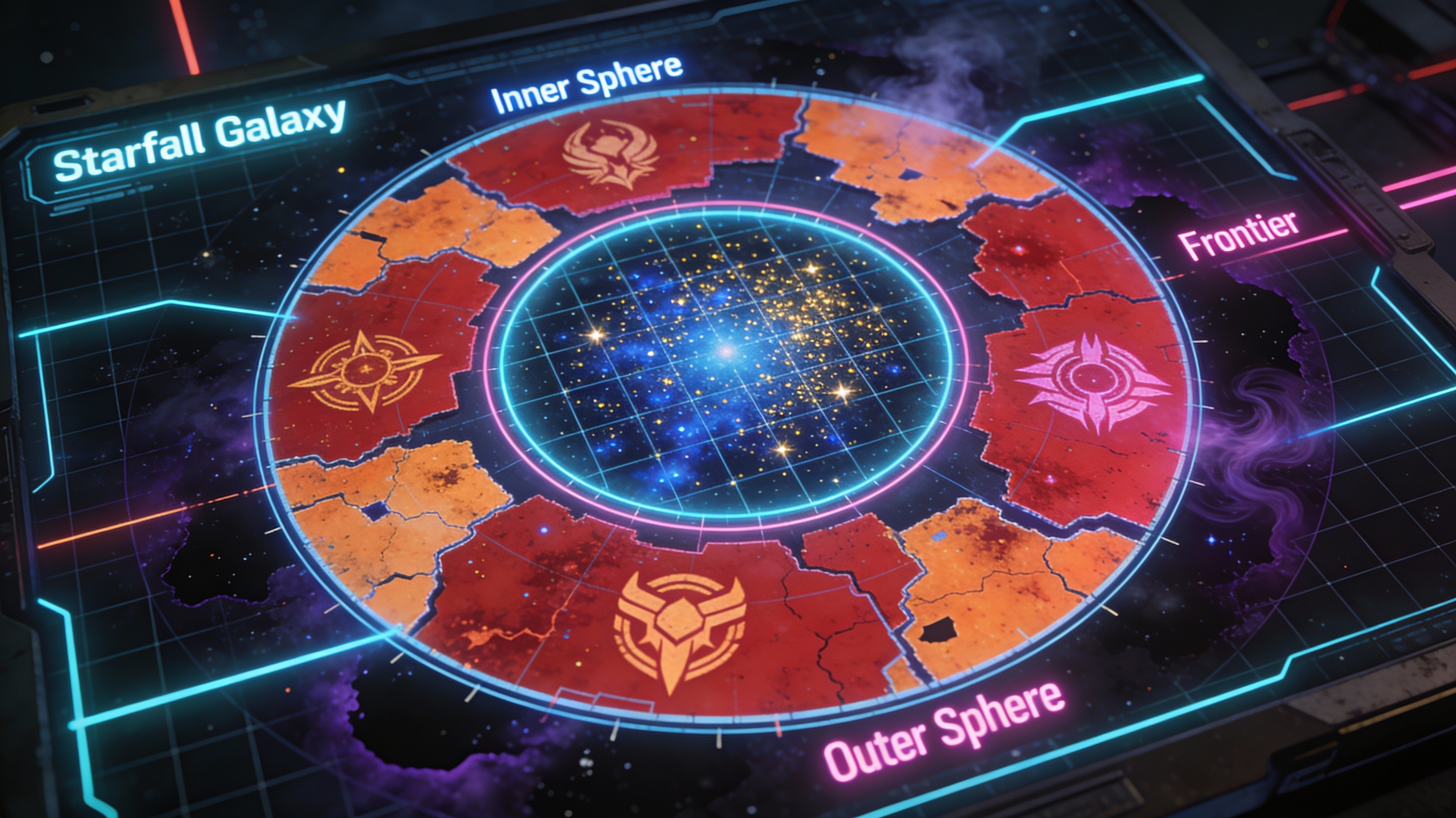
The Starfall Galaxy spans an immense, largely uncharted realm, shaped by millennia of cosmic upheaval and by civilizations both ancient and new. Species, factions, and technologies have woven a tangled web of alliances and rivalries, creating a living history of settlement, migration, rebellion, and rediscovery. A vast network of trade, travel, and communication divides the galaxy into three principal regions: the Inner Sphere, Outer Sphere, and the Frontier.
The Inner Sphere
Once a bastion of prosperity, the galactic core now outwardly projects order but secretly battles decay. Governed by the law of the Commission, it is a hub of trade, industry, culture, and knowledge. Despite its glittering wealth, poverty and inequality simmer beneath the surface, as subtle planar influences from the Rift begin to take root.
Outer Sphere
Further from the core, the Outer Sphere is a harsh tapestry of empires, kingdoms, and tribes. Life here is marked by constant struggle, and conflicts are often settled through resource battles or brutal warfare. The Outer Sphere is defined by its relentless pacing and the clash of competing ambitions.
The Frontier
The furthest reaches are the Frontier—a realm of peril and untold riches. Sparse settlement, unexplored systems, and ancient ruins make this region ripe for adventure but fraught with danger. Here, travelers may find long-lost civilizations, forbidden laboratories, precious minerals, or deadly anomalies. Some return bearing great knowledge or fortune, while others are lost to the void.