Northlanders
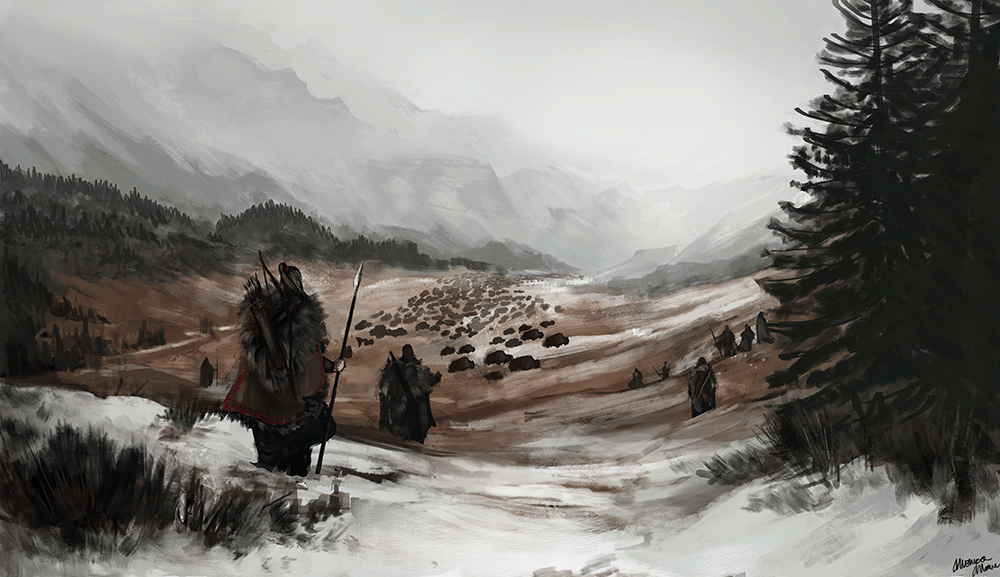
Northlanders are known to be stout warriors who live off the land, pray to their ancestors, enjoy honey meads, and see portents everywhere. Among them, strength is respected, weakness abhorred, and sharp wit tolerated. A skald and wise woman are staples of every village, the former to minister to the mind, and the latter the spirit.
They emigrated to the valley generations ago. Almost exclusively human, these barbaric people live in the grassy prairies and foothills known as the Borars. Intensely insular and quick to violence, the tribal Northlanders have not made any attempt to integrate with other societies.
Relations
Northlanders value strength, independence, and cunning. Traits they often find lacking in outsiders.
- Amore: The city-dwelling folk of Amore are, by and large, weak and unable to survive in the truly rugged environs of the valley. They are not welcomed among the tribes.
- Eldrinael: Very little interaction exists between the Eldrinael and the Northlanders, but the barbarians respect the elves whom they see as kindred spirits, if a little on the weak side.
- Ptah: The dwarves of Ptah are respected for their strength and courage, the gnomes are a mystery, and the halflings of Ptah are welcomed in all tribal lands for their friendliness and gentle spirits.
Society
Northlanders are self sufficient, dependent almost entirely on the bison herds for sustenance throughout the year. Food, shelter, and prestige can all be claimed from a successful hunt. While the bison provide for the Northlanders, their proclivity to capture and tame the region’s predators, such as dinosaurs and wolves, has allowed them to maintain control of these wild lands in the face of vast goblinoid hordes in the nearby mountains.
There are two broad social classes among the tribes: warriors and civilians. Unwed warriors live, eat, sleep, drink, and carouse in the great hall, while civilians live in longhouses capable of housing up to twenty family members. These homes typically include several generations of a family.
The Names of Things
In Borars, villages are referred to as “highhouses,” and their leaders either “highman” or “highwoman.” Bards are known as “skalds,” and married women as “goodwives.” Most homes are called “longhouses,” and every village has a communal longhouse called a “great hall.”
Festival of Oxmead
The culled bison are taken back to the temporary highhouse where fully one-third of the population Northlanders waits to assist with the processing. Every part of the bison is used, from the hides which are tanned, meats that are smoked, and bones ground up or shaped into implements. When the work is done and the hunters returned, the Red Feast begins. Clan by clan, family by family, they feast on the abundance of bison and oxmead. Every Northlander is expected to partake in the Red Feast at least once every three years.
Finally, with their families provided for, the warriors gather into war parties numbering 75 to 100 (along with dinosaur mounts and entire packs of trained wolves) and make for the low mountain passes. Here they scour the mountains for goblin caves. When they find one, they gather en masse and slaughter the goblins within, often suffering significant casualties. They use large boulders to seal the caves, seeking to disrupt food stores and hobble the goblins, who vastly outnumber the Northlanders. Many believe the annual Scouring is all that keeps the goblins from overrunning the entire valley with their immense numbers.
Finally Oxmead ends when the victorious survivors limp out of the mountains, returning to their clans. By this time, the temporary highhouse has been dismantled and clan rivalries are back in full swing.
Oxmead
The heady Oxmead is a specialty drink brewed by Northlanders. Made of strongly fermented milk and kept chilled until served, it satisfies hunger as a full meal, but has twice the alcohol of most drinks.
Honor
Northland warriors tell the story of their life as “honor.” Their honor consists of three short sentences, defining moments that, taken together, reveal the warrior’s true face. When they talk about each other, they introduce the subject of their discussion by reciting that person’s honor.